Radiology Arbitrage Will Revolutionize the Medical Malpractice System
Andrew Wilmot MD · September 8, 2026 at 11:15 AM ET · edited
Radiology Arbitrage Will Revolutionize the Medical Malpractice System
The medical malpractice system adversely impacts all physicians, both through the threat of being named in a malpractice lawsuit, and through the detrimental impact defensive medicine has on the daily practice of medicine.
Perhaps one reason that the medical malpractice system avoids greater scrutiny is a lack of transparency. The National Practitioner Data Bank reports only on the minority of medical malpractice cases that result in a malpractice payment. The courts themselves track only the number of malpractice suits filed, while neglecting to track a wealth of critical information including the number of physicians sued per case, the medical specialties of the defendants, the defense costs, and the amount of work missed by defendants. The AMA relies on survey data to determine the rate at which physicians are sued, and this is typically reported as a single national average. All of these methods fall short of providing a comprehensive understanding of the true impact the medical malpractice system has on physicians and the healthcare system. The gold standard would start with an accurate count of physicians named as defendants in malpractice lawsuits per year broken down by county, state, and medical specialty.
Why radiology is in a unique position to alter the medical malpractice landscape (and why you shouldn’t stop reading even if you aren’t a radiologist)
About a year ago, I happened upon a CME lecture which provided a far more insightful look at medical malpractice than any provided by the courts, the NPDB or the AMA. The talk, entitled “137 Years of Medical Malpractice,” was delivered by Benjamin Strong, MD who serves as the CMO of VRAD. Dr. Strong compiled and analyzed data on all malpractice cases closed by Vrad between June 2017 and October 2020. While the data is specific to diagnostic radiology, the results are relevant to all practicing physicians.
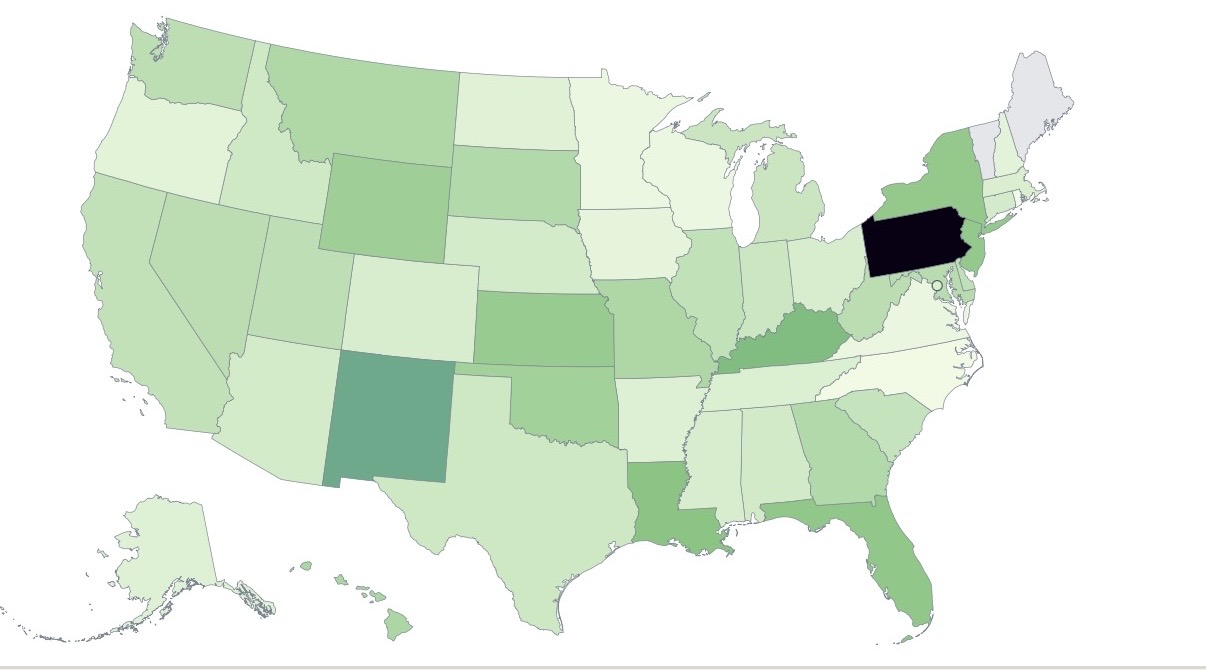
The VRAD data contains a wealth of information, but what struck me most was the geographical variation in the data. Dr. Strong reviewed in detail all cases resulting in indemnity, and used the data to calculate a relative risk of malpractice for each state. The three states which presented the greatest risk for malpractice were Pennsylvania, New Jersey, and New Mexico.
Take Pa for instance. Pa accounted for 4.9% of all VRAD study volume and 18.7% of payouts, resulting in a relative risk of 3.8. By contrast, Texas accounted for 9.4% of study volume and 0.25% of indemnities. Comparing Pa and Texas head-to-head, a radiologist reading a case for Pa was at approximately 150 times the relative malpractice risk as a radiologist reading a case for Texas.
Part of what makes the VRAD data so interesting is that their diagnostic radiologists have multiple state licenses and work as teleradiologists. The data is therefore somewhat analogous to a randomized controlled trial in which radiologists individually and collectively were contemporaneously subjected to the medical malpractice system for almost every state in the country. Therefore, any discrepancy in the rate of malpractice from state to state cannot plausibly be attributed to any difference in the quality of work provided by the radiologists. In fact, Dr. Strong’s analysis revealed that two thirds of the radiologists involved in malpractice cases were below the average “miss rate” based on VRAD’s own comprehensive internal data, and two thirds were also below average in terms of productivity rate, countering the common arguments put forward by plaintiff’s attorneys that radiologists face malpractice claims as a result of inaccuracy and/or greed.
The perfect storm
A perfect storm has struck radiology. There is a shortage of radiologists both in the US and throughout the world. This shortage has in turn led to increasing turnaround times and imaging backlogs, making radiology a major bottleneck in healthcare delivery. Furthermore, with the emergence and expansion of teleradiology, diagnostic radiologists are no longer restricted to working for the state in which they live. Radiologists are now able to perform their own unique form of geographic arbitrage, whereby they can live wherever they like within the United States but can choose to read cases for health systems in different states, taking into account factors such as compensation, lifestyle, and medical malpractice climate.
If faced with choosing between two jobs with identical pay and schedule, one of which involves reading exclusively for Texas and the other exclusively for Pennsylvania, then why would any radiologist choose the latter?
The healthcare system and the legal system have yet to adapt to this new reality. States are still relying on the number of radiologists living within their borders to determine whether their patient population has sufficient access to radiology services. States with malpractice climates that are unfriendly to physicians are still chugging along as though radiologists have no recourse to being sued. They do so not only at their own peril, but unfortunately also at the peril of their citizens. It is my opinion that as radiologists become attuned to the geographic variability in medical malpractice, the states with the worst malpractice climate will become the states with the worst radiology backlogs.
Why can’t we trust our medical societies to fix this? How about the insurance industry? The hospital lobby? Politicians? The court system?
As long as physicians allow themselves to be treated as pawns in the medical malpractice system, there is no incentive for any of these entities to fix the system. Medical societies may be well intentioned, but their budgets and by extension their power are small relative to other lobbying groups. Even if medical societies committed their entire budgets to fighting for medical malpractice reform, they might still make little progress on the issue, and it would detract from other worthy endeavors. The insurance industry may be irked by rapidly rising malpractice costs in certain counties and states, but it is far more convenient for them to simply raise rates than to fight on behalf of a profession that will not stick up for itself. The hospital lobby has the primary responsibility of keeping hospitals afloat. As long as the costs of medical malpractice are not bankrupting hospitals, the impact on physicians is a secondary consideration.
As for politicians and the courts, like politics all medical malpractice is local. Going back to the example of Pa, the trial lawyer PACs in Pa donate large sums to support Democratic Pa Supreme Court justices. The Pa Supreme Court in 2022 reversed a venue shopping rule introduced twenty years earlier, thereby allowing plaintiff’s attorneys to preferentially file cases in Philadelphia, known for high verdicts and high rates of finding in favor of plaintiffs. Before the venue rule was reversed, Pa was already ranked second in the nation for medical malpractice payouts.
Just how entrenched in their positions are Pa politicians when it comes to medical malpractice? Take this quote from Democratic State Senator Steve Santasiero at a hearing on malpractice reform on October 27, 2025: “If you think you’re here to testify about medical malpractice you are mistaken. You’re here to support yet another attack on the foundations of our democracy.”
If you want something done right, do it yourself
I completed my training as a radiologist in 2013. Over 13 years in practice, I have faced two lawsuits, and I have spent 8 of my 13 years in practice fighting malpractice lawsuits. While I have yet to pay a cent in the form of a settlement or judgment, I have been instructed to miss months of work for depositions, trial preparation, and scheduled trials. In one case, the trial was rescheduled five times. I have yet to be involved in a trial, which is perhaps not surprising given that only approximately 5% of cases ever do go to trial. It is unconscionable that nobody is accurately tracking the opportunity costs of medical malpractice, including but not limited to lost physician work hours and defense costs.
When expressing my frustration over the Pa malpractice system, the most common responses I have received over the years have been along the lines of ‘it’s the cost of doing business’ or ‘the only way to fix it is through the ballot box’. Well, if ‘it’s the cost of doing business’ then why not preferentially do business in the states where the costs are a fraction as high? And how does one fix an issue through the ballot box which is understood by perhaps one percent of the population?
A second reason that medical malpractice avoids greater scrutiny is that it is treated as a monolith, whereas it varies tremendously both geographically and over time. The reality is that throughout the majority of the country, the medical malpractice system works reasonably well. But in certain counties and states the system has become a tremendous drain on healthcare resources. Treating it as a monolith only serves to provide cover to the court systems where medical malpractice runs rampant.
It is time to stop waiting for somebody else to fix the malpractice system. It will not be fixed until it is shown unequivocally that it is adversely impacting patient care. Ironically, once this is shown, the system is likely to self-correct very quickly. That is why my goal is to track medical malpractice data with a level of detail and accuracy never done before. By demonstrating which counties and states present the greatest threat to doctors, and empowering doctors to choose jobs that protect their best interests, states and counties with the most unrestrained malpractice systems will be forced to adapt.
It might be tempting to believe that once these efforts bear fruit and the most problematic court systems adopt a more balanced malpractice system, that the job is done. Unfortunately decades of experience proves otherwise. As long as courts in certain counties and states accept large donations from trial lawyers, the likelihood of recurrence is high if not inevitable. The goal is to continue to monitor malpractice trends in perpetuity, thereby identifying problematic geographical malpractice trends as they arise, like a game of Whac-A-Mole. This isn’t a moon launch. Compared to the complex medical research being performed by doctors across the globe, simply tracking court data and identifying geographic discrepancies is simple, yet vitally important.
So to all of the physicians reading this I say: please join the mission to hold the medical malpractice system to account, empower physicians, and improve US healthcare. And to those who have benefitted from the pay-to-play malpractice system in states like PA, NY, NJ and NM I say: you’ve been served.
The opinions and positions expressed in this article and on this website are those of the author(s) and do not reflect the positions of WVU, UHA or WVUHS.