The Pennsylvania Court Dockets Experiment-Part I
Andrew Wilmot MD · October 16, 2026 at 10:57 AM ET · edited
The existing data on medical malpractice is profoundly insufficient. Whether this failure is by design or by oversight can be debated, but what is not up for debate is that the total number of physicians sued per year must be accurately tracked by specialty, county, and state. We can no longer rely on survey data from the AMA. Surveying subjects about a topic that carries a stigma is inherently prone to inaccuracy, not to mention that national averages are misleading when the rate of lawsuits against physicians can differ by orders of magnitude from one state to another. We cannot rely on NPDB data. This tracks only payments and completely ignores the large percentage of doctors who experience years of litigation but in the end do not have their name submitted to the NPDB. Doctors are conditioned to feel grateful that their name is not put in the NPDB, but this is perhaps the greatest insult of all. It says in essence ‘your experience didn’t count’. The courts literally collect all of the data necessary to provide accurate data on lawsuits against doctors and to calculate the costs incurred by the health system. Yet they don’t even analyze it. At least in Pennsylvania, medical malpractice court dockets do not even get shared with the state database. This makes studying the data extremely difficult. States only report the number of medical malpractice cases filed per year, and don’t even accurately track how many doctors are sued per year.
The Pennsylvania Court Docket Experiment happened by accident. I tried searching the state database for records of malpractice cases filed against me, and there were no results. I came to realize that the state does not track this data, and so I moved on to the county court dockets. I started by looking at the Philadelphia court dockets. They are accessible for free but do require setting up an account and agreeing to terms of service, as is the case for all counties. On my first search I found zero results for any lawsuits against ‘Andrew Wilmot.’ But there was a result for ‘Andrew Wilmont’. It is amazing to think that this system that subjects us to years of litigation, demands that we miss or reschedule large chunks of work at its behest, and demands huge sums of money in our names, cannot even spell our names correctly.
Once I found the court dockets for the cases involving me in Philadelphia and Allegheny Counties (one each, I’ve been sued twice in total) I then began to ask myself whether I could use the search engines to systematically identify and study malpractice cases in these counties. For Philadelphia, after communicating with a few court clerks, I was left with the impression that if I wanted to search for all medical malpractice cases, it would involve paying the courts to perform an advanced search. But amazingly, when I called the Allegheny County Court, a clerk explained to me exactly how I could identify all medical malpractice cases in the Allegheny County Court Dockets. I tried it and it worked! I am looking to my readership to help me determine exactly how I can submit this data to rigorous analysis. As an experiment, I went through all malpractice cases filed in Allegheny County in 2021. I recorded the names of each physician defendant (only so I could then identify their specialty) for each case. In total I counted 97 cases with doctors named, and a total of 172 named doctors. That works out to 1.8 doctors named per case. Specialties that were represented by a single case (ophtho, ent) are not included in the chart.
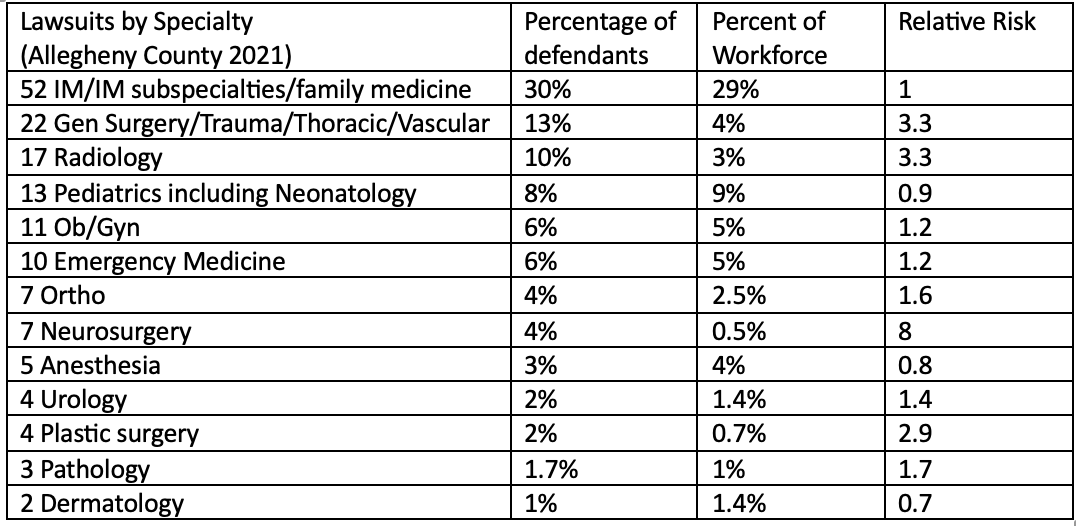
I divided each figure by the total and then compared to the percentage of physicians nationally under these categories to calculate a relative risk. For example, IM/FM made up 52/172=30% of the named defendants and from research online I concluded that IM/FM accounts for approximately 30% of US physicians, therefore the RR is about 1. Of course, this is just one year of data. I suspect these were unusually low years for ER and OB/Gyn in terms of RR.
What I’d like to do is enlist some help to develop a systematic way to record and analyze the data from Allegheny County over the last 10 years. I’d like to record the number of doctors sued and their specialty. We could analyze trends in lawsuits against specific subspecialties. These trends would reveal how plaintiff’s attorney strategies evolve over time. But it would also be nice to record data that might reflect the length and cost of a case. I’m open to any ideas. Maybe this work would have some appeal to an academic health policy department.
I’ll leave it at that for now. Part 2 of The Court Docket Experiment will go into my investigation of malpractice cases against private practice radiologists in Pennsylvania.
The opinions and positions expressed in this article and on this website are those of the author(s) and do not reflect the positions of WVU, UHA or WVUHS.